Stay Away, Do Not Play: How to Teach a 3 Year Old What Not to Touch
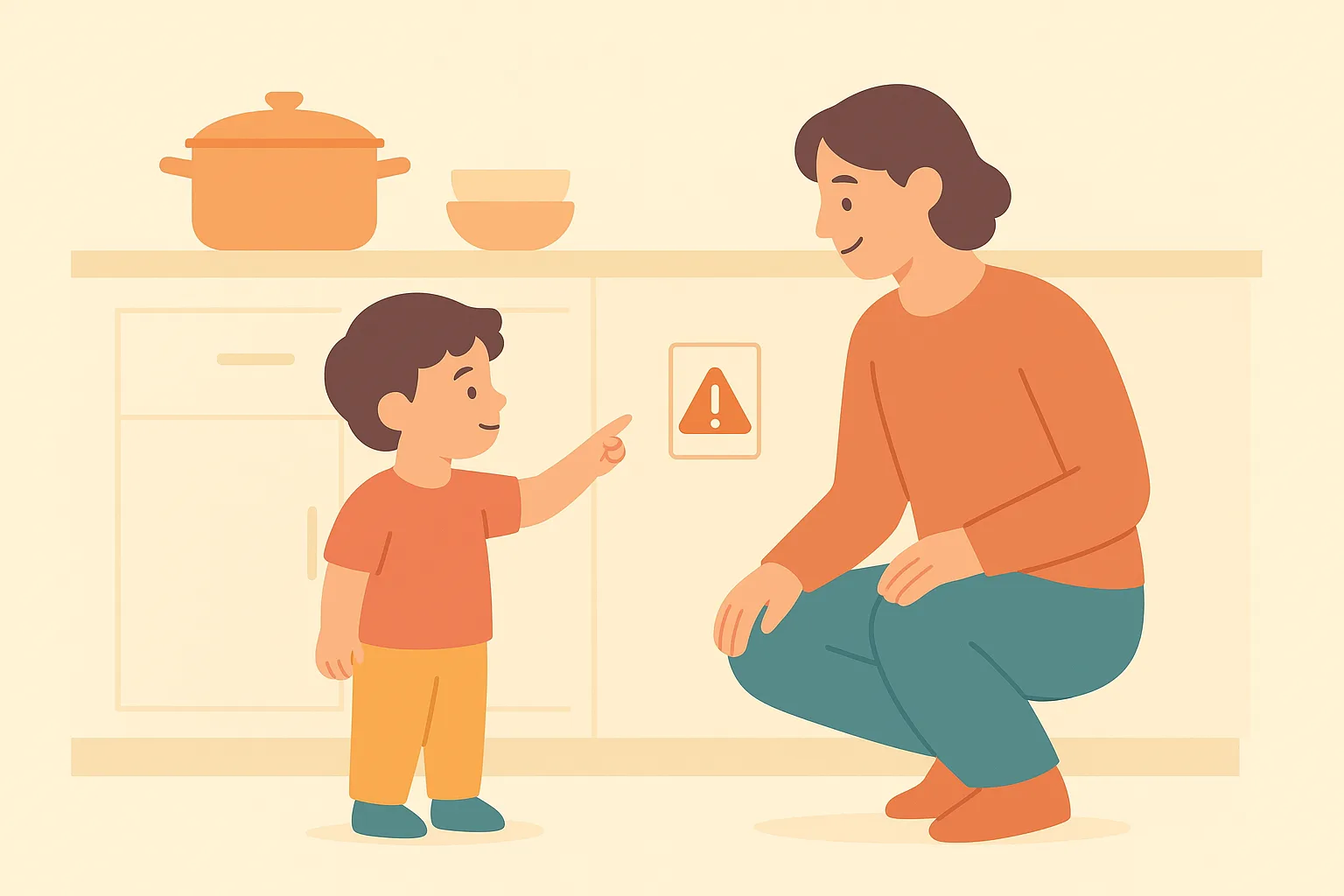
"Don't touch that" is the most common safety sentence in any house with a 3 year old, and it barely works. The child hears it, stops, and reaches again the moment you turn around. That's not defiance. At 3 to 5, "don't" is an instruction for right now. What you want is for them to know, on their own, that the stove is a "no" thing and the spoon is a "yes" thing.
The way to get there is to make the child the one who decides. Chapter 1 of the PreSafe workbook is called "Means No", and its whole method fits in one line: the child looks at an object, decides whether it can hurt them, and marks it. They do the sorting, so the rule becomes theirs.
Step 1: give "no" a picture
Young children remember pictures and rhymes long before they remember reasons. Start with a symbol. In the workbook it's a red circle with a line through it, the same sign they'll see on doors and packaging for the rest of their life. Draw one on a card and say the rhyme with it:
"No is where you should not go. No means that I stay away. No means that I do not play."
Say it a few times over a couple of days until they can finish the line for you. That symbol now means something.
Step 2: label the house together
Cut out small paper labels. The workbook's set reads Never Touch, Hot Burn, Lick Sick, Sharp Cut, Water Shock, Electricity Shock, Always Lock, Never Talk. Make your own if you like, with a picture on each.
Then walk the house with your child and ask, room by room, "Where does this one go?" Let them pick. Let them stick it on. The oven door, the knife drawer, the bottle under the sink, the outlet by the crib, the medicine cabinet, the front door lock.
Two things happen here. They learn the specific objects in their own home, not a drawing of a generic kitchen. And because they placed the label, they keep checking it. A label a parent put up is wallpaper. A label a child put up is theirs.
Step 3: play Stay Away, Do Not Play
This is the game the whole chapter uses. Set out some objects on the table: a toy, a spoon, an empty lighter, a bottle of cleaner, a ball, a pair of scissors. Hold each one up and ask, "Can we play with this?"
When it's a yes, they get to hold it. When it's a no, you both put the symbol on it and say the rhyme. Keep the tone light. You're not scaring them. You're sorting.
The workbook does the same thing on paper, with pages of household objects and a front yard scene where the child draws the symbol over each hazard. "How many dangers can you find?" is a question 4 year olds love to answer.
Step 4: repeat in the real room
A week later, walk the kitchen again and ask them to show you the "no" things. Do the bathroom. Do the garage. Ask "What could happen if we touch that?" and let them tell you, in their words. "Hot. Burn." is a complete answer at this age.
One tip: the four-step way the workbook frames every hazard is worth stealing for anything: name it (this is fire), say what it does (fire is hot), say what it does to you (fire can burn your skin), say how that feels (burns are bad and make me sad). The last step is the one that sticks, because it's about them.
What "no" is really teaching
A child who has sorted the "no" things in their own house has learned something bigger than which drawer holds the knives. They've learned that some things are off limits, that they get to notice which ones, and that saying no to an unsafe thing is normal. That's the foundation the rest of the workbook builds on: the stranger rhyme, the water rule, the fire drill. Every one of them starts with a child who already knows how to stay away.
What to do next
Chapter 1 of the PreSafe workbook has the labels, the symbol pages and the Stay Away, Do Not Play scenes ready to print. The rhyme and the short chapter video are free in the Learning Center.
Questions parents ask
- Is 3 too young to learn what not to touch?
- No. A 3 year old can sort objects into safe and unsafe when you show them, and they can learn a two-line rhyme. What they can't do is remember a spoken rule without practice, which is why the labels and the game matter more than the talk.
- Won't labels make the house look like a construction site?
- For a couple of weeks, yes. Take them down once your child can walk you to every "no" thing without them. The habit stays.
- What about things I can't label, like a hot cup of coffee?
- Use the symbol card. Hold it up next to the cup and say "no thing". After a few times they'll say it for you.
Explore the PreSafe Early-Age Safety Workbook
7 essential safety chapters, fun activities, catchy rhymes, and lifetime access to all video lessons. Everything you need to keep your little one safe.
You Might Also Enjoy
How to Get a 3 Year Old to Wear a Bike Helmet (and Keep It On)
Most helmet fights with a 3 to 5 year old are about fit, timing or the fact that nobody else is wearing one. Fix those three and the helmet stops being a fight. Here is how, plus the rhyme that helps.
A Room-by-Room Home Hazard Hunt for Kids Ages 3 to 5
A hazard hunt is a walk through your own house where your child does the finding. Here is what to look for in each room, and the questions that get a 3 to 5 year old thinking instead of just nodding.